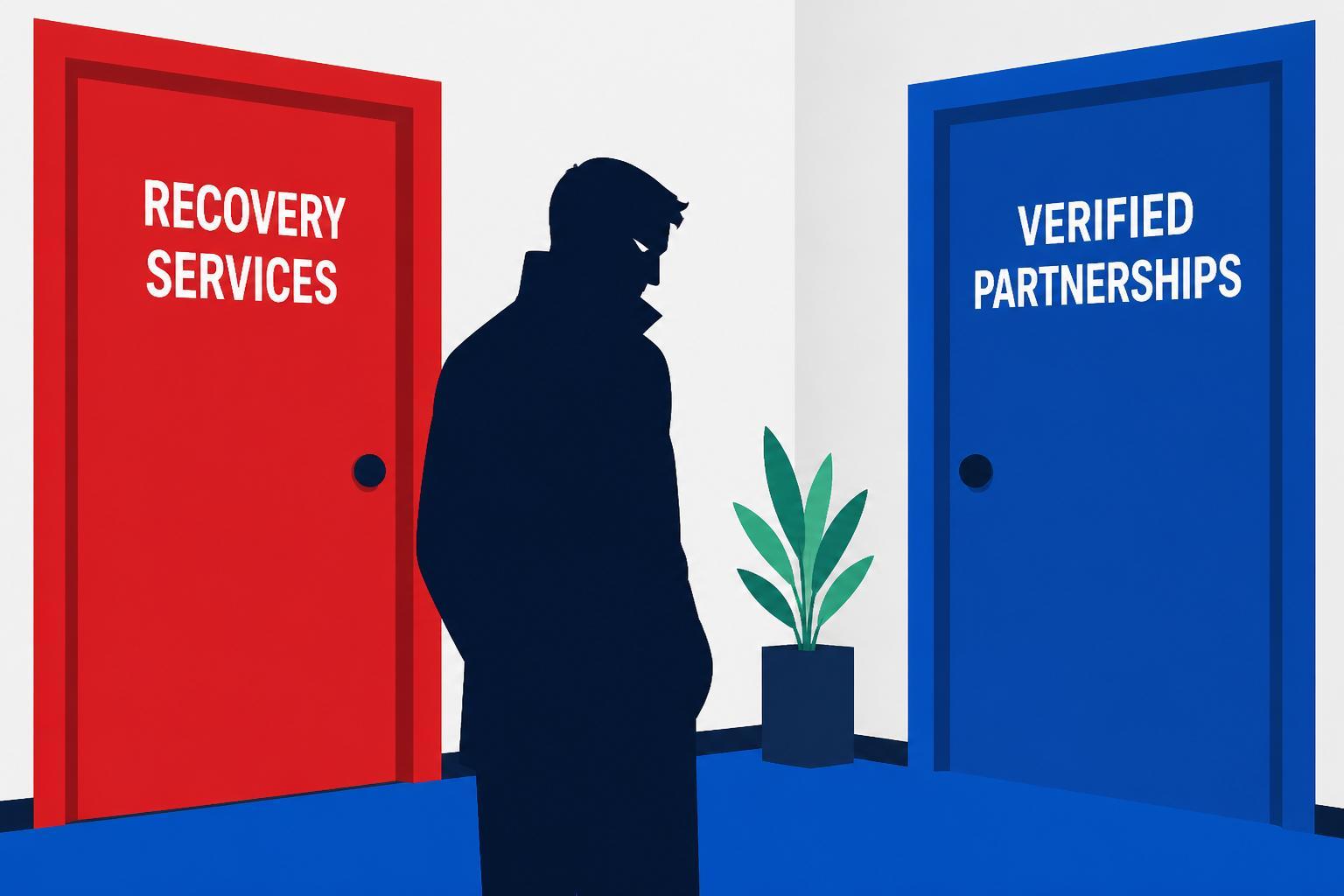
The Deceptive Threat
A ransomware affiliate is masquerading as a legitimate incident-recovery service. Here's how it works: after deploying ransomware, they approach victims as a third-party recovery firm, offering to restore systems and negotiate reduced ransom payments. Their goal is to redirect ransom payments to themselves while pretending to provide legitimate incident response.
This isn't hypothetical. It's happening now and reveals a major flaw in how organizations vet their incident response partners during a crisis.
The Fraudulent Process
While the exact timeline of these operations isn't fully documented, the pattern is clear:
- Ransomware is deployed.
- Victims discover encrypted systems and seek help.
- The fraudulent recovery service contacts the victim (often via search engines, forums, or direct outreach).
- The "recovery team" offers to negotiate or restore data.
- Victims pay what they believe is a reduced ransom or recovery fee.
- Payments go to the affiliate, not a legitimate service.
- Victims may or may not receive decryption keys, depending on whether the affiliate maintains the deception or disappears.
The most dangerous phase is between steps 2 and 3. When systems are down and costs are mounting, the urgency to act can override normal vetting processes.
Missing or Failed Controls
This scam succeeds when three controls are absent or weak:
Pre-incident vendor relationships: Organizations scrambling to find help during an attack lack established trust, verified contacts, and contractual protections. They're searching online while systems are down.
Vendor verification procedures: Even with procurement processes, emergency vendors often aren't covered. There's no verification that "ABC Cyber Recovery LLC" is legitimate and not a shell company.
Insurer-approved panel requirements: Many don't realize their Stand-Alone Cyber Policy includes an Insurer Consent Requirement for incident response vendors. Using an unapproved vendor can void coverage for response costs. If that vendor is the attacker, you've just paid a ransom your policy won't reimburse.
Standards and Requirements
NIST CSF Core Function IR (Incident Response) doesn't explicitly address vendor fraud, but IR-2 (Incident Response Plan) requires pre-identifying qualified response partners. NIST SP 800-61 Rev. 2 recommends establishing relationships with incident response providers before incidents occur. Section 2.3.2 advises identifying and preparing to use external resources, including forensic consultants and incident response teams.
The Insurance Data Security Model Law requires insurers to implement comprehensive security programs. For policyholders, this means you must demonstrate reasonable procedures to verify a vendor's legitimacy if claiming incident response costs under a cyber policy.
Your cyber policy likely includes a requirement to obtain insurer consent before engaging third-party vendors for covered services. This isn't just red tape, it's a control to prevent scenarios like this. Insurers maintain a panel of verified incident response firms with established credentials and performance history.
Action Items for Your Team
Establish your incident response panel now. Don't wait for an attack. Identify three to five qualified firms, verify their credentials, and set up retainer agreements or confirmed contact procedures. Check references, verify they have professional liability coverage, and confirm they're on your insurer's approved vendor panel.
Document verification procedures for emergency vendors. Create a checklist your team can use even during a crisis: verify business registration, check certifications (CREST, GIAC, etc.), confirm a physical office and established web presence older than six months, and call a known reference. This takes 30 minutes when you're losing data. Do it anyway.
Review your cyber policy's vendor consent requirements. Find the section on Insurer Consent Requirement in your policy. Understand which vendors need pre-approval and which can be engaged with notification. Get the insurer's 24/7 claims hotline number and the current approved vendor list. Store both in your incident response plan and runbook.
Update your incident response plan to include vendor verification steps. Between "Declare incident" and "Engage forensics team," add "Verify vendor identity using established procedure." Make it a required step. Assign it to someone not managing the technical response.
Test your vendor contact procedures. In your next tabletop exercise, simulate the scenario where your primary incident response firm is unavailable. Can your team quickly verify and engage an alternate? Do they know where to find the approved vendor list? Do they understand the difference between "approved for immediate engagement" and "requires insurer pre-approval"?
Train your team to recognize high-pressure vendor tactics. Legitimate incident response firms don't cold-call during an attack, promise guaranteed decryption, or ask for payment before providing credentials and a statement of work. If someone contacts you unsolicited during an incident, that's a red flag requiring additional verification.
The ransomware affiliate posing as your recovery team isn't just stealing your ransom payment. They're exploiting the chaos of incident response to bypass every control you'd normally use to vet a critical vendor. The defense is preparation. When your systems are encrypted and your business is offline, you won't have time to verify credentials. You need to have done that work already.